28 July 2014

One good turn deserves another

With the recent spell of hot weather  - hay making has been in full swing.
Good hay generally takes about a week to make - so we are very dependent on a settled spell.
For example, Martins' Meadows were cut on a Monday , then turned three times (Tuesday, Wednesday and Thursday) to dry and make the hay and then on Friday it was all hands on deck -  rowing up, baling and carting the hay to get it all safely stored in the barn at Foxburrow Farm. This process is of course delayed if there is any rain. We all spent the week with our fingers crossed that it stayed fine and looking anxiously up at any looming cloud.

This year, I was given a lesson in turning the hay and was very pleased to spend two afternoons driving the tractor up and down with the 'Hay Zip'  (Turner or Tedder) which fluffs up and dries the hay. The picture on the right shows a 'Turner's eye view'.

The 'Hay Zip' is also used for rowing up the hay in preparation for the baler. A clever alteration of the tines from turning to rowing position, leaves the hay in rows that the baler can then go up and down.
By using a hay sledge behind the baler, bales are delivered on to the field in groups of eight which can then be collected by the bale grab and loaded on to a trailer. The picture below shows rowing up and the hay baler and sledge in action.

Hay cutting machinery is notoriously sensitive and many things can go wrong along the way so it is really satisfying when things go to plan and we end up with a sweetly- scented hay stack in the barn.

I am extremely grateful to all those who help make the hay cuts on the meadows happen each year. Tasks range from everything from servicing the machinery, getting machinery to site, operating and  mending the machinery, making sure the barn is swept out and clean for receiving the hay, knowing how to build a hay stack and unloading the bales. Invariably, the weather is sunny and warm, making the whole process a hot and generally sweaty experience and a far cry from 'one man went to mow, went to mow a meadow' - it takes a few more than that!  - So a big thank you to you all.

17 June 2014

Tall 'tails' from the meadows

The month of June sees the hay meadow grasses all racing into bloom. Walks through the meadows are accompanied by clouds of pollen being carried on the breeze. My dog  Ellie's face is lightly dusted pink and yellow with  pollen and grass anthers and we both frequently sneeze.


Many of  grasses have English names that reflect both their habitat and appearance . 'Hay' grasses often include 'meadow' in the name such as meadow barley, smooth meadow grass and  meadow fescue. Sweet vernal grass, reflects it early flowering and the sweet taste and scent it contributes to hay. Some  reflect their resemblance to other farm crops and farm animals  such as false oat grass, yellow oat grass and cock's foot (right). Yellow oat grass catches the light 'illuminating' parts of the meadow just as gold-leaf illuminates manuscripts.


Other grass are named after tails various. Meadow foxtail  (below left) acquires the two tone rusty colour and white tip of a fox's tail as it flowers.


Small cat's tail (right) does indeed look like a cat's tail  - though whether small
 refers to the size of the cat, tail or grass is open to debate!

Crested dog's tail (below centre) resembles the tail of a dog, but again I'm not sure which is crested - the dog or the grass? Ellie's tail is much closer in appearance to the meadow foxtail and if she ever goes exploring in  this grass her her tail is well camouflaged.

7 June 2014

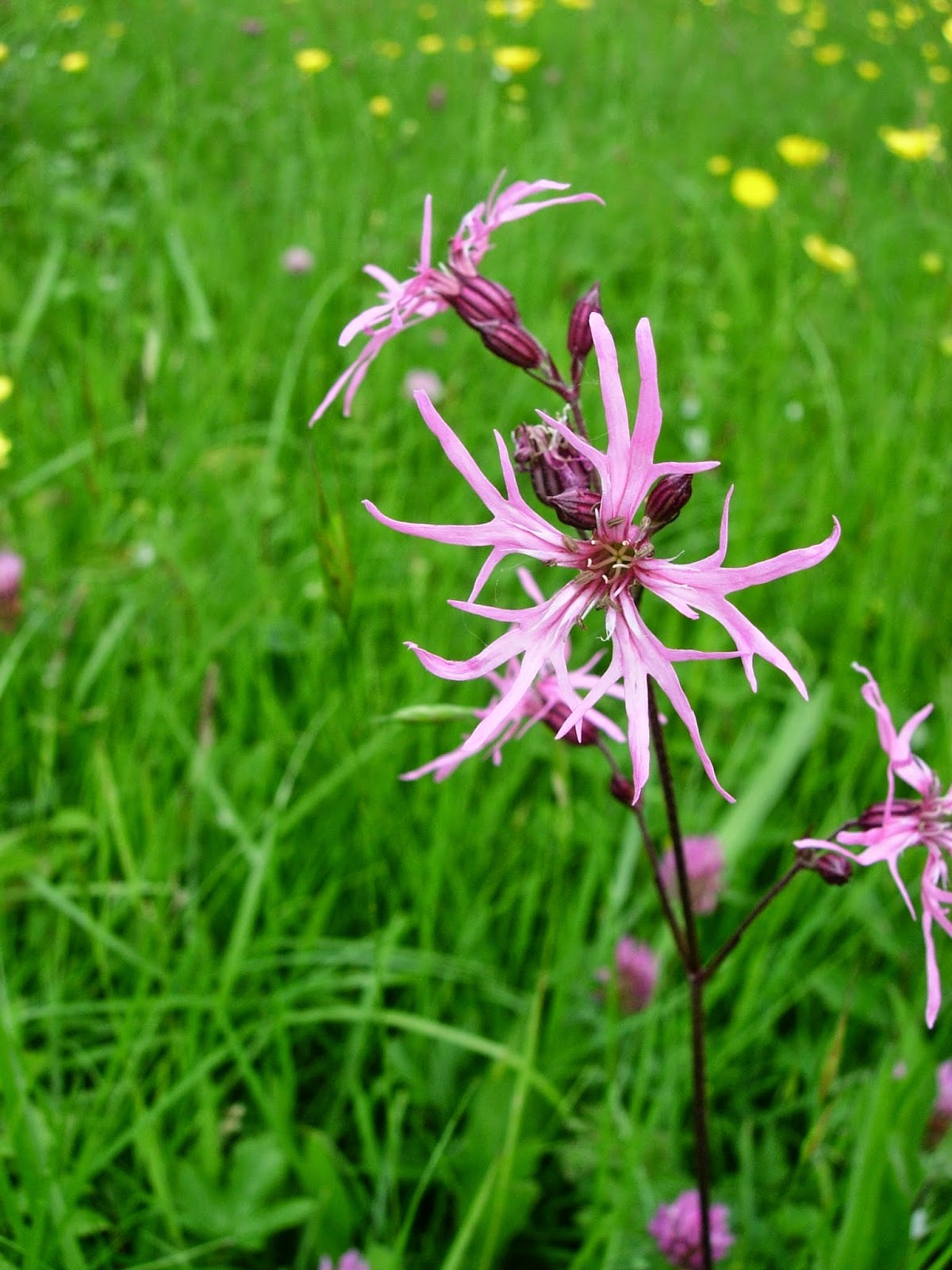
A ragged rascal


When I was a child my granny taught me the tongue twister  -
'A round the rugged rocks the ragged rascal ran' and I am always reminded of this when the 'ragged robin' flowers in the meadows -  its  flowers almost appearing to be  'running' through the meadows.


Found in the damper areas of  meadows, marshes and fens, this distinct flower is a member of the Caryophyllaceae (Campion) family which includes red and white campion, the catchflies , the chickweeds and the stitchworts. It is the only one on the family that has these raggerty deep cut petals and is unmistakable when in bloom. Flowering at the same time as the meadow buttercup, its spiky pink  flowers contrast  dramatically with yellow haze of  buttercups -  so can be easily spotted, almost appearing to  be suspended above the meadow on its very delicate stems.
.

A taste of honey

It is well known that our bees are in trouble and in decline - so I was delighted to be contacted by a local beekeeper about having beehives at one of our meadows. Our herb-rich meadows are a vital source of pollen and nectar for bees so having bee hives seemed an obvious way to help and encourage bees.

For the first season the hives remained unoccupied - but then it was a very wet summer. However, last year the beekeeper introduced a swarm to one hive and this was quickly followed by the other hive being adopted unaided - so we have full occupation.


It is a joy to see the hives in action and there is no doubt there is plenty of flowers for the bees to visit and this year we were rewarded by being given the first fresh honeycomb by the beekeeper. I have not yet started my honey but I am sure it will be suffused with buttercups, green-winged orchids and red clover.

We are very grateful to Neil Page who is the beekeeper -  both for the honey, but more importantly for establishing bees at the meadows and regularly visiting to make sure they are still doing well. Having bees at the meadows seems somehow to make the meadows complete and is a great reward and motivation for maintaining the meadows in good condition for wildlife.

24 April 2014

'Pearing up'


In the last week or so, we have been experiencing some glorious spring weather, with clear blue skies providing a striking back-drop to emerging blossom and leaves.

The clouds of white flowers on the orchard pear trees at Martins' Meadows really caught my eye -  particularly when pictured close-up.

Even now, at this early stage in the year you can already see  the immature pears taking shape behind the blousy flowers.
Not possible to show on a blog - but when I visited, the blooms were alive with the sound of bees - so hopefully there will be  good pollination and the promise of a good harvest if the sharp night frosts didn't catch the trees.


6 January 2014

Midsummer in Midwinter

Over Christmas and New Year, I have been helping out with checking the Suffolk Wildlife Trust livestock.

With the grass no longer growing, it is necessary to supplement the grazing with hay. Most of the hay we are feeding was harvested from the  SWT hay meadow reserves back in July.

On a cold and frosty or wet and windy morning in December - the warm sunny days of hay-making are  rather a faded memory - but as you cut open the bales into the in the hayracks, it is like cutting into a slice of midsummer in the midwinter. The scent of the hay and the  many flowers and grasses clearly visible momentarily  recapture July. Knapweed, clover, yellow rattle, sweet vernal grass, meadow barley and crested dog's tail are all easily discernible - the plants of summer immortalised in a bale, providing a welcome hay feast.

2 December 2013

Winter colour

During the short days of November and December when the skies are often wood pigeon grey - it hardly seems to get light. Low light levels seem to make the world a rather drab place and it becomes harder to find inspiration and solace. However, look closely and both can still be found - all but on a subtler scale than during the blousy, carefree days of summer.


Vibrant lime-green mosses seem to almost shine in the grass, re-hydrated and easier to see in the shorter aftermath grazed sward. The bare branches of shrubs and trees are more clearly visible now the leaves have fallen and mosses and lichens are much more apparent.

Micro-carpets of mosses are almost like velvet on tree branches and lichens appear like splashes of yellow ochre or flaking Verdi-gris - all providing winter colour on a micro-scale.


17 October 2013

Multi-tasking

Whilst checking the sheep at one of the meadows recently, I was very struck by the amazing structure of some teasel heads in the ditch and how they have evolved to be so 'multi-purpose'.
Earlier in the season, the tall stems carry the flowers aloft, advertising the tightly packed flowers to passing insects for pollination. The close packing of the flowers seems optimise the number of flowers over a given surface area - all interlocking with not an air gap to see.
The sharp spines on both flower heads and stem protect the flower from grazing and the hollow stems given strength but with economy of structure.
After pollination, the seed heads act as shakers and rattles for dispersing the seed ( if the flocks of goldfinches don't get there first).
On dewy autumn mornings, intricately worked spiders' webs are clearly visible, the spiny framework of the flower heads providing an ideal support over which to drape over the sticky snares.

12 September 2013

In the aftermath of summer

After the summer hay cut, the meadows quickly green up and begin to grow again - putting on 'aftermath' growth.
In most years, it helps site condition to late summer or autumn sheep graze this aftermath.
The timing of  grazing varies from site to site and season to season, but generally the first meadow to be aftermath grazed is Fox Fritillary meadow.  The meadow is on relatively fertile floodplain alluvial soils and so quickly 'springs' back into growth after the haysling.
We delivered a flock of SWT Hebridean sheep to this meadow in mid August.  At first their task looked like a daunting one, but they soon set about nibbling back and revealing the fence lines, as well as tackling the tall herbs along the edge of the ditch and any docks or thistles that try to creep into the sward.
The sheep do an excellent job in encouraging the grass to 'tiller', which tightens the sward and helps prevent bare patches where undesirable  plants like ragwort, creeping and spear thistle might otherwise establish.
Although the sheep do generate a certain amount of nutrients as dung, the overall effect of aftermath grazing is a second harvest of the meadow. There is net movement of nutrients off the meadow in the form of nutrients that have been assimilated into the fabric of the sheep -  so when the sheep leave the meadows so do the nutrients!
The sheep dung is also a useful source of organic matter and can  be important for soil and dung invertebrates.
The grazing means that the sward is low at the beginning of the next growing season. This tends to favour wildflowers that are intolerant of shading and competition from taller grasses. The snake's head fritillary pushes up its delicate leaves before the taller grasses get going, giving it a head start in the photosynthesising stakes. Low growing plants like adder's tongue, bugle and cowslip which would soon be engulfed by large grasses also take advantage of this early window.


27 August 2013

Seeking a refuge

Hay-cutting is a very necessary and important part of the management of the meadow reserves - but from the perspective of a grassland insect, the hay cut must be a very dramatic change of scene!

Obviously we need to cut the hay to maintain the wildflower diversity of the meadows on which the insects in part depend, but we can reduce the impact by leaving uncut refuges for insects, particularly pollinators like bees.


On each of the hay meadows, we leave an uncut refuge strip of about 5-10m wide.  Aftermath grazing by the sheep helps trim these uncut areas up later in the year, but we also vary the  location of the strip each year to prevent scrub invading the  blackthorn is particularly quick to silently creep into the meadow
 when the cutter or sheep have turned their back!

The refuge strips also provide a graded and gentle edge to the meadow, which adds structural diversity and increases the range of habitat niches.


Hopefully many species benefit from these strips, though I think the field vole may question their value when the barn owl hovers overhead finding the strips very convenient quartering!


24 July 2013

On bale

What a contrast the weather has been this year compared to last for haymaking.
A wet summer really hampered the 'haysling' last year, whereas this year a run of fine, dry weather has allowed the process to go relatively smoothly with our hay harvest from the meadows safely cut, baled and stored by the end of last week. My thanks to the great team who worked so hard to make it all happen.
There was even time to step back and admire our hard work and I could not resist this picture of Ellie, triumphant on bales at Martins' meadows  or to put it another way - she is 'out on bale for good behaviour!'

18 July 2013

Docks (or Rumex) often go unnoticed as a component of meadow flora. Some species like curled dock (Rumex crispus) and broad-leaved dock (Rumex obtusifolius) are considered undesirable in all but the edge of meadows as they can be indicators of poor sward condition and less than ideal management – they readily colonise areas of bare ground created by over-grazing or compaction and reduce the quality of hay.

Wood dock (Rumex sanguineus) as the name suggests, can often be found at the edge of meadows growing in the shade of hedgerows

Common sorrel (Rumex acetosa) is the most typical meadow dock and is very much part of the open hay sward. Its diminutive cousin, sheep’s sorrel (Rumex acetosella) occurs on drought prone grasslands and heathlands.

At first glance, docks are rather too green or brown to readily catch the eye, but at certain times of year and when looked at in close-up, they really are quite fascinating.

As the seeds ripen they slowly flush from green to red to a rich burnt umber – almost giving the appearance of going rusty. The ‘red seed ’phase is particularly obvious in common sorrel and sheep’s sorrel, both of which can turn a meadow or heathland scarlet in early summer. The seeds of common sorrel are almost translucent hanging like strings of lanterns amongst the grass.

Each species of dock has unique shape and form of fruit. When looked at closely through a lens the ‘architecture’ of the fruit is astonishingly intricate. Some resemble shield bugs or trilobites whilst others look like a green and red fried egg on a string!

 
So next time you see a dock - take a moment to 'ruminate' on Rumex!


2 July 2013

Rattling around


Yellow rattle or hay rattle - Rhinanthus minor is one of the most intriguing plants of hay meadows. It is semi-parasitic on the roots of grasses and where it is abundant it can appreciably suppress grass growth. For this reason, in the past when productivity of hay meadows was so important, yellow rattle was not favoured as it reduced hay yield.

Unusually for a grassland plant, it is an annual – totally dependent on setting seed each year to survive. It quickly sets masses of seed in June – seemingly perfectly timed to precede the hay cut! 

The seed is held in the ‘balloon’ like sepals and as these dry out and the seed ripens, so the cases ‘rattle’ and the seed is shaken out in the breeze.  Hay-turning also helps scatter and spread the seed. 

Yellow rattle’s life style is well adapted to the hay meadow yearly cycle – so conserving hay meadows is key to this plant’s survival.

29 May 2013

The keys to the future?

With the unwelcome arrival of ash die-back last year, it is with some apprehension that I have been watching the unfurling of the hedgerow ashes at the meadows. So far, so good - the fresh green leaves seem to be  emerging from the dark buds with their usual grace.  However, it is really too early to tell and I will be keeping a watchful eye in coming months and years.

An unexpected benefit of this need for careful observation, is that it has encouraged me to look much more closely at a tree which is so familiar I often hardly give it a second thought - except to ponder whether we are in for a 'splash or a soak' depending on whether the ash or the oak comes into leaf first and whether it will be a good or bad hay year! (The spring has been so late and condensed this year the two trees seem to be pretty much neck and neck at the moment).

I am not sure I have ever before paused to look so closely at the ash and to catch a photograph of it just as the ash keys are beginning to form. I was really struck by the almost translucent 'toffee apple' brown of the keys, contrasting dramatically with dark bud scales and vibrant new green leaves.

Let's hope that somewhere in the many bunches of ash keys now forming -  there is some natural resistance to ash die-back - that at least some of the keys will unlock a future for the ash.


22 May 2013

New home at Mickfield

In the last couple of years, I have often seen a Little Owl sitting on the entrance gate at Mickfield. So I was delighted, when earlier this year, I was offered a Little Owl box to put up on one of the oaks at Mickfield.
The box was very carefully made and generously donated to us by a Suffolk Wildlife Trust volunteer - Bob Dunsdon. Thanks Bob - much appreciated.

On a cold blustery spring day a few weeks ago, Stuart Holland and I set off for the meadow and installed the box.

It is certainly a very impressive 'high rise' apartment, with fine views over the meadow and the scarce goldilocks buttercup at its feet.

25 April 2013

In the last week or so, spring has finally sprung - leaves and flowers unfurling almost as we watch. Primrose, cowslip, barren strawberry, blackthorn and cherry plum -  all hunched and tight shut against the cold for so long, rapidly shrug off winter, throwing their flowers open to the sun.

But the ground is still cold, so the real spring growth surge, when the meadows seem to double in height overnight, has not yet begun. This means that early flowering species are particularly visible this year as their flowers are carried above the short sward.

At Mickfield Meadow, the Wood Anemone  - Anemone nemorosa is a striking example of such an early species. Patches of this delicate species waiver in the spring breeze.

Wood Anemone or Wind flower is a strong indicator of ancient and undisturbed land. It is more commonly associated with ancient woodland than grassland, its early flowering taking advantage of higher light levels before the woodland canopy closes over.  But old, undisturbed grasslands have many of the characteristics of ancient woodland glades and rides so it should be no surprise that Wood Anemone can occur in both.

28 March 2013

A Murmur of Spring


As we slowly trudge on through the coldest March since the early 60’s, with the collars of our thick coats turned up against the biting easterly winds - the promise of spring and summer still seems distant -  despite the passing of the spring equinox and changing the clocks this coming weekend.

The meadows appear much as they did in November, quiet and still against grey leaden skies.

But stand still, watch and listen for a while and all is ‘a-chatter’ with a murmur of spring.
 
Flocks of fieldfares run in fits and starts foraging in the grass, well camouflaged and hard to see until they are disturbed and noisily rise into a nearby tree. 

Photo by Darin Smith


Starlings too, busily feed, searching for grubs, with their sharp beaks - ‘aerating’ the meadow as they go. Their flocks almost seem to roll like waves as they work across the meadow – gently all rising and then settling again to feed in another area.  Like the fieldfares, when startled, they head to a hedgerow tree  and remain silhouetted in the branches whistling and chattering until it is safe to return. 

Photo by Darin Smith


All this 'conversation' in the trees, must I’m sure include at least a mention of the hope  that spring will soon arrive - after all when does a conversation in this country not include the weather!

14 March 2013

The benefits of insulation


We are all aware of the benefits of insulation to help keep out the winter cold. This week’s late snow and cruel easterly winds were a stark reminder to try and shut out the draughts from our homes and only venture out in lots of layers! 

Up at Winks Meadow, high up on the Claylands of Suffolk, the easterly winds cut across the former Metfield airfield and there is seemingly very little shelter. 

However, on a day of sub-zero temperatures, fleeting sunny spells and with much of the meadow covered in snow, I was amazed to see grassland spiders running about amongst the tussocks of grass. 

Snow does of course act as an insulating blanket, creating slightly warmer conditions beneath - but I think the secret of this early activity of the spiders was the undulating micro-landscape of the grassland. A series of miniature hills and valleys created by the tussocks and rosettes of the grasses and broad leaved herbs – forming a sheltered network of lee-sides, tunnels and cavities where the spiders could carry on despite the freezing conditions above. Definitely a case for keeping their heads well below the snowy parapet!
 
Seeing the spiders in the meadow on a day like this really highlighted the importance of micro-topography and structure of grassland, the benefits of extensive grazing and always leaving some ‘raggety’ bits as refuge and shelter to enable wildlife to get through the winter.

26 February 2013

Hedging

In the raw, bleak days that we have been experiencing lately, days spent working outside don't hold much appeal. However, January and February are an ideal time of year to carry out hedging work on the meadows. The berries of the hedgerow shrubs have mostly been eaten by the birds and it is still too early for birds to be thinking about nesting.
Hedgerow management at the meadows is mostly rotational coppicing, with a priority being to coppice elm that has started to succumb to Dutch elm disease.  Coppicing elm helps to rejuvenate it and makes sure this characteristic hedgerow species continues to survive in our  hedges.

The work can look drastic immediately after it is done, but the coppiced shrubs quickly put up strong shoots in the new growing season and in a few years a really dense hedge has re-grown. Only a short section of hedge is coppiced in any one winter so that there is always a good range of ages and structure to the hedge and cover for birds and other wildlife is always maintained.

Mickfield
Last week the Suffolk Wildlife Trust mid-week volunteer team undertook some coppicing at both Mickfield and Fox Fritillary meadows - despite the cold the team completed two good sections of hedge and hopefully found the task a good way to keep warm in a particularly perishing week!
Framsden
 I would like to thank Stuart Holland (mid-week conservation team leader) and his team for all their hard work on the meadows' behalf. Thanks also to Stuart for the photographs.


11 February 2013

Just the Thicket

At this time of year, the focus of the meadows tends to be on the edges and hedges rather than the grassland itself.  The boundary features are not only the framework within which the meadows sit, but also provide valuable links and wildlife corridors that connect nature reserves with the wider countryside.

The winter months are the ideal time to carry out management on the hedges and scrub, causing minimal disruption to wildlife and its habitat. Working rotationally on these habitats further reduces any impact, as a refuge is always maintained even when seemingly quite dramatic work such as coppicing is undertaken.

One of the tasks this winter has been to begin to rejuvenate and thicken a block of blackthorn scrub.

This species can form really dense thickets which are favoured by species like bullfinch. However, as the blackthorn matures it becomes quite drawn and leggy in character and begins to loose its 'thicket' quality.  The thinner structure is less valuable for birds.The answer is to coppice it in rotation to encourage denser re-growth.


The block of blackthorn we have worked on at Martin's meadows this year has been 'high' coppiced  with the aim of ensuring the new growth is above rabbit feeding height. We did coppice a small area a couple of years ago  down to ground and the rabbits made swift work of removing all the re-growth! We have learnt our lesson and have tried a different tack this year.  Hopefully the result will be strong dense growth, thick enough to suit bullfinch and from which you can hear this bird's faint  but distinctive whistle like song. (Photo of bullfinch by Darin Smith)